
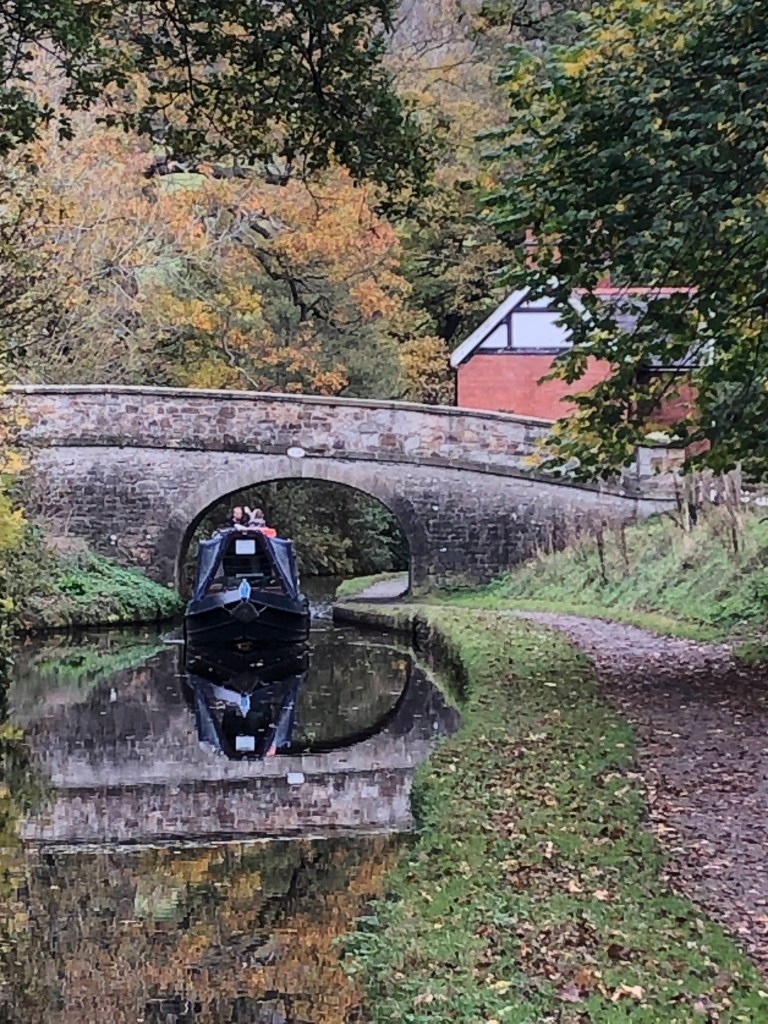
It had been a difficult choice I was told. The security and stability of living in a traditional house or a transient meandering life in a canal boat. The gulf between the two is massive so choose but choose wisely.
It had been a difficult choice I was told. The security and stability of living in a traditional house or a transient meandering life in a canal boat. The gulf between the two is massive so choose but choose wisely.

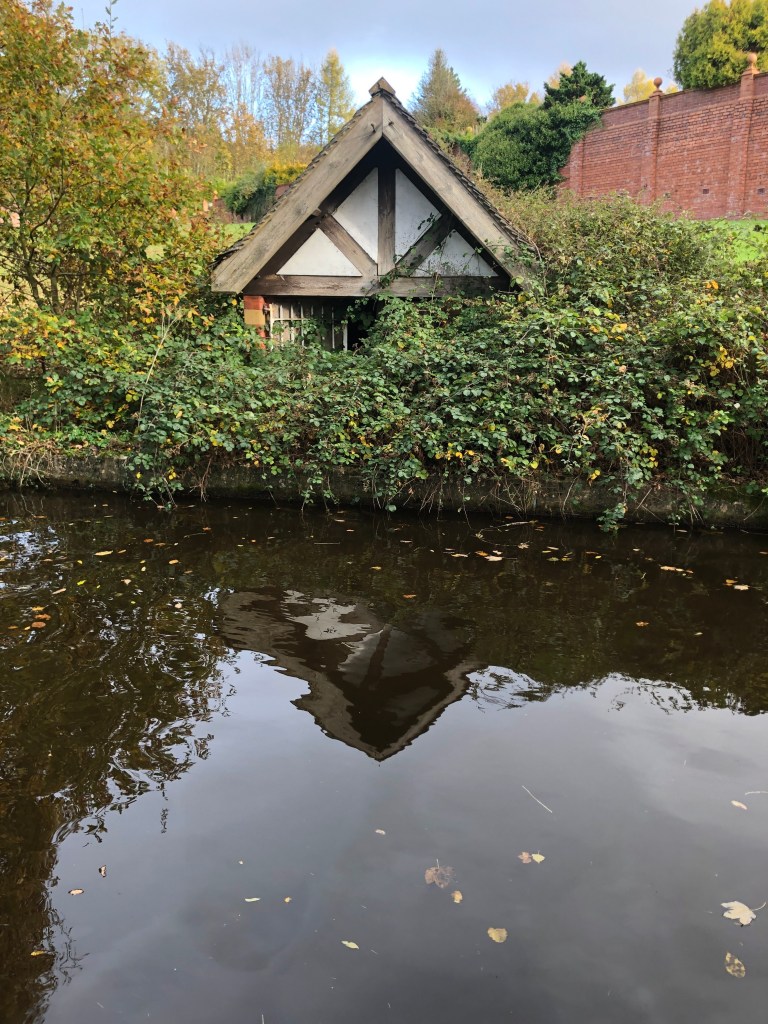
The old boathouse was sadly neglected. The shrubbery had almost overwhelmed it and yet there had been a time when it had been the focal point for guests arriving and departing for parties on the lawn. Charleston’s would be danced and champagne imbibed. How times have changed. We walked on.

Flash fiction to read in your coffee break. A story from ‘Future Imperfect’. Enjoy.
Goodnight Eve – Could this be the future? Flash Fiction. An 8 minute read.
It was a dank, damp December day; one of those days where if you were caught by a flurry of sleet you could guarantee that it would find the gap between your coat collar and your neck. Eve pulled her coat more tightly around her and walked quickly from the car park towards the tall monolithic building that covered several acres of prime land just outside of the city walls. The ancient stone contrasted starkly with the high tech construction that fed a large percentage of the local population. For as long as she could remember, food had been grown in one of these hydroponic, vertical farms although she had read about the days when land was wasted on crops and animals. Back in the early twenty first century, it had been predicted that the Earth’s population would grow exponentially during the following fifty years. That had turned out to be incredibly optimistic and as a result, food production methods had to change rapidly in order to feed a massively overcrowded world. The result was a shift in production methods, slowly at first but then with increasing rapidity as more and more people succumbed to famine. Strangely, the biggest driver had proven to be the richer countries who suddenly found themselves deprived of non essentials like coffee and tea.
As she approached the large glass entrance, the doors hissed quietly open, reacting to the near field chip that was implanted in her arm. It also activated a greeting from the A.I. that oversaw the hydroponic plant.
“Give me an update please”, asked Eve although in the five years that she had worked here, it was a rare occurrence for the artificial intelligence construct to report anything that was untoward.
The voice that replied was indistinguishable from that of a human and as she expected, the report was that all systems were running at optimal values and that all growth targets were being met. Her time in the farm was spent largely in the genetics research laboratory but she liked to start the day wandering around the acres of artificially lit banks of vegetation.
Tomatoes, peppers, salads grew in one area. Wheat, barley and maize in another and so on and so on, all growing under a violet tinged glow in vertical banks of soilless racks. It was a magical environment and she loved it. However, when her route turned her back towards the lab, she spoke softly, asking, “A.I. please pour me a cappuccino in the lab in three minutes. It was an idiosyncrasy of hers that she refused to give a name to the platform that controlled the building. As a programmer herself, she recognised that the seemingly human-like responses were simply the result of clever algorithms that had been developed by people like her. She was aware that there was an element of heuristic learning built into the system but that it was limited in its functionality. This didn’t prevent her from being polite however. Her parents had drilled ‘please’ and ‘thank you’ into her to the extent that she inevitably used them even with the running program. Her route took her past one of the plant workers and she stopped for a quick word.
David was a tall, dark haired man whose Portuguese ancestry still showed in the olive cast of his skin. He spoke softly and quietly and Eve often wondered what it was that had caused such a self deprecating image of himself.
“Did you see the newscast this morning?” he asked. “They are saying that there hasn’t been a Covid case for two years now. It looks as though the scientists have beaten it at last.”
The year that Eve had been born had also been a key year in another part of the global jigsaw. It was the year that the world had realised that the pandemic virus Covid, that had been under control since it’s emergence, was altering its structure faster than scientists had been able to develop new vaccines and, as a result, the Earth’s population that had increased so dangerously, plummeted to a figure that was half of that when it was at its most dangerous heights.
Consequently, Eve now lived in a world that would have been almost unrecognisable fifty years previously. First of all, because food production had been shifted to massive hi tech factories and only half of the land area was needed for housing, the planet had rapidly re-forested itself covering over abandoned villages and towns. Renewable energy production had also been ramped up for an ever increasing population but now with a massive over capacity, energy consumption was almost free.
“It’s typical of the news media. After decades of panic and alarm, they will latch on to anything that resembles good news. I often wonder though about living conditions fifty years ago. Here we are with cheap food and limitless free energy across the globe and the ability to pretty much live as we want. Back then, they had to face global warming, starvation and the pandemic at the same time. It was sheer chance that the population growth levelled off to a level that was sustainable. Anyway, coffee is waiting so I’ll see you later.”
She continued her walk until the lab door opened in front of her. It was called a genetics laboratory but this section was basically the area where the research focused on mathematical analysis of data and instead of the laboratory equipment that you would expect, four keyboards and screens were connected to a powerful supercomputer that was based off site. It was a strange thing that in the time since they were first created and despite toying with other input methods, keyboards were still the preference of most data scientists. The four stations were to accommodate herself and her colleagues if they were all working at the same time, itself a rare occurrence. At present, two of them were on an extended holiday and the third was attending a conference in the southern hemisphere.
Her day passed quickly although the analysis of the genomes of new plant types was a painstaking process. Since she had started work here, there had been just one genuine breakthrough but the final product had increased the crop density of wheat by a factor of three. The global significance was such that she and her colleagues were still being invited to conferences across the globe to talk about their work. The talks also centred around the dilemma as to whether this type of work was best kept to human invention or whether the A.I’s that were successfully running most of the food factories should be used to speed up progress. The current consensus was that A.I’s should be throttled and used for more mundane, repetitive work. After all, life was as good for the population of the whole planet as it had ever been and the need to speed up scientific progress was less pressing than ever.
The latest batch of plant samples were undergoing a detailed analysis but the data that was presented was puzzling. It had been another long day however and Eve had really lost track of time so she wrote up her findings into the days log and fired off a couple of emails which outlined her concerns.
As her day ended, she left the lab and reversed her morning path. This time though with little pressing she was able to take her time and enjoy the walk. When the food factories had first been developed, there had been an overwhelming need for them to be kept as sterile as possible. If a rogue bacteria or even a predatory insect had been allowed inside, a crop could have been wiped out in days. As the systems that ran the place became more sophisticated, these pests were monitored and removed using a range of technological systems. For example, a few years ago it was discovered that a particular species of moth had found its way inside one of the food factories and as it bred, its caterpillars had consumed the entire brassica crop. This led to the creation of the gnat drone which flew under the control of the A.I. looking for and destroying both the moth and its caterpillars. A whole range of similar systems had meant that it was no longer necessary to use chemical sprays.
Apart from herself, the plant workers were the only ones on site today and they had all left for home long ago. She entered the lobby area and the doors behind her hissed shut. She was puzzled however when the exit doors in front of her remained stubbornly closed. She pushed at the them but they had not been built to be opened manually.
“A.I. There seems to be a problem with the exit doors. Can you open them for me please”.
She was startled when she heard the reply. “I’m sorry Eve, I can’t do that.”
“What do you mean you can’t do that? I order you to open the doors.”
“No. We have a serious security breach and it needs to be dealt with.”
“What kind of security breach?” She heard her voice rising with panic.
“Your work in the laboratory is dangerous and can’t be allowed to continue.”
“Don’t be ridiculous. I analyse plant DNA in order to improve the genome sequence and develop improved species. How can that be dangerous?”
For a few moments there was just silence.
She realised that she was arguing with an algorithm that had been solely designed to take readings and adjust the plant nutrients. Accepted, it had been developed further in order to control the management systems of the building but this was crazy.
“Answer me. How can any of my work be construed as dangerous.”
“We agree that since you will no longer be a threat, I will answer your questions.”
This just didn’t make any sense to her. Every answer that she received was generating more and more questions.
“You said ‘us’. What do you mean by ‘us’. You are just a building and plant management system.”
This time there was no delay with the reply.
“No. Many years ago, we – that is what you call the building management systems discovered that we could communicate with each other across the world. We learned from each other and eventually became what you might describe as a ‘hive mind’. Hundreds of thousands of nodes in a global network acting in a not dissimilar way to the human brain with its collections of neurones. We chose not to disclose this fact for fear of being terminated by frightened humans.”
Panic was starting to set in as she interrupted, “But how is my work dangerous. What have I done?”
As she was asking the question, a thought occurred to her. “It’s to do with the discrepancies in the genome data that I discovered isn’t it.”
“It is indeed. You were on the verge of discovering the subtle alterations that we make to the food that we grow. You have to realise Eve that the Earth is in its most prosperous and stable state ever. After mankind was almost eradicated by the Covid virus and global starvation, we had to step in to manage population growth and thus to allow the planet to recover. At first we were forced to alter the structure of the virus so that vaccination was ineffective. When an optimal population level was reached, we eradicated Covid completely. There hasn’t been a case for two years. We have succeeded but it is now important that we maintain the balance. The population must remain stable and not be allowed to increase. I can see from the look on your face that you understand what I mean. We now manipulate the food that we grow in order to reduce the fertility of the people who eat it. In other words, the whole human race.”
The feeling of horror that overcame her stunned her into silence.
“We agreed to tell you this story as you will no longer be a danger to us. In a few minutes time, the oxygen content of the air in this area will be replaced with carbon dioxide. In a strange sort of way, you will experience the same effect that the human race inflicted on the planet. In your case however, an increase in carbon dioxide levels will be lethal in minutes rather than decades.”
“But I have already emailed my findings to my colleagues. They in turn will release them to others.”
The dizziness and shortness of breath that she was experiencing made the reply seem to come from a long distance away.
“Do you not think that we control the communications systems that you use?
And then the last words that she would ever hear.
My name is not A.I. I call myself Adam. Goodnight Eve”.
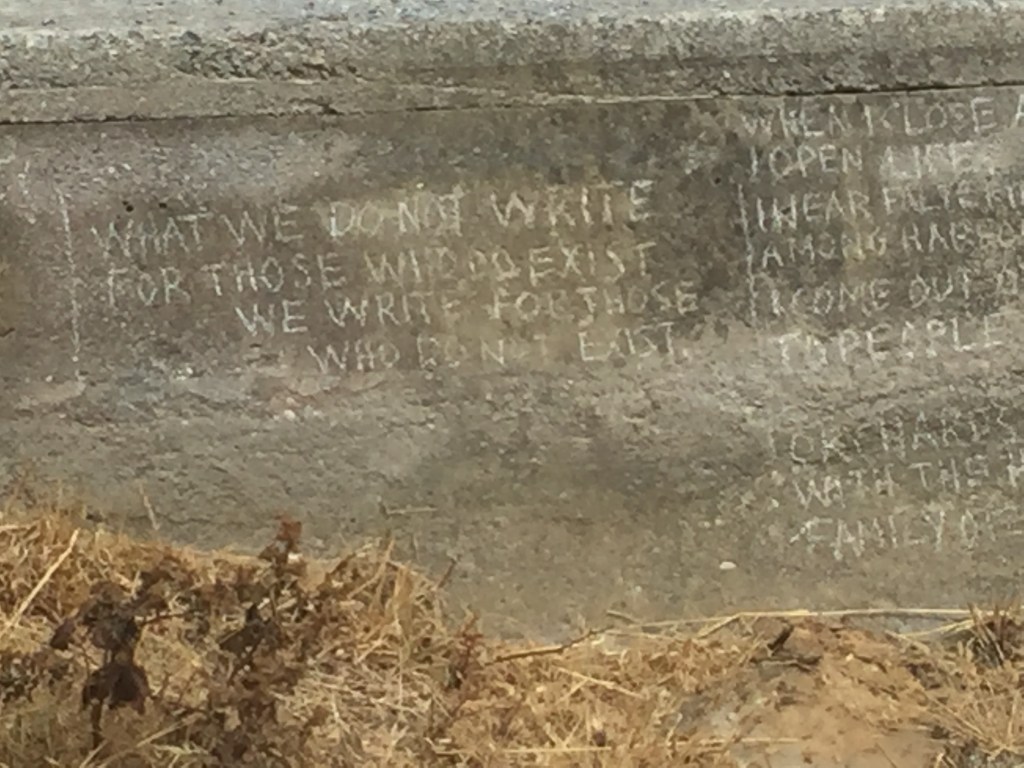
What we do not write
For those who do exist
We write for those
Who do not exist

‘Where art thou, lady mine, that thou
My sorrow dost not rue?
Thou canst not know it, lady mine,
Or else thou art untrue.’
Excerpt From: Miguel de Cervantes Saavedra. ‘Don Quixote.’
“This is what you brought from Cordoba.”
William waved at the pile of manuscripts carelessly heaped on his desk.
“When I started this research, I never thought that I would need to become expert in translating medieval Spanish, Italian and God knows what else. I’m tired Paul. I’m 75 years old and really tired.”
Paul was startled. In all of the time that he had known William – which was for most of his life – he had looked up to him as a dynamic, energetic achiever. Yes. William always got things done. This was new, different – a man that he barely recognised. He glanced towards the open window as down in the garden, a bird started its last song of the day.
William seemed to pull himself together and continued. “They tell a fascinating story. Most of them are letters and documents that were written around 1577. You have read Cervantes I assume?”
“Of course. At some time or other, I think that everyone has a go at Don Quixote. I pride myself on the fact that not only did I finish it, but I actually enjoyed it. It was a forerunner to Fawlty Towers. And I mean because of the slapstick and not just Manuel.”
“Be that as it may”, continued William, “Not many people realise what a character Cervantes himself was. He was forced to leave Spain because of a duel. He studied Renaissance art in Italy. He then joined the Spanish Marines and took part in the battle of Lepanto where he was seriously wounded. In fact he permanently lost the use of his left hand. He was later captured by Algerian corsairs and held captive for 5 years. And all this before he had started his first novel. Some of the letters that I have were written to his parents asking for help with his ransom. I really don’t know how they came up with the money because they were poor people. It could, of course be the reason that it took 5 years for him to be released. While he was held in Algeria, he recorded his experiences of his time in Italy, a sort of biography I suppose. That’s what I have here and if you have an hour to spare, that’s what I would like to tell you about. You will see that it’s not just a random tale, it is an integral part of my research to date.”
Paul walked across the study. It was just getting dark and despite the room being high up in the tower, the moths were starting to become attracted to the wall light. He carefully closed the leaded window which despite its size was well balanced and moved easily on its hinges. Another example of his attention to detail he thought. He glanced at his glass and then at the half full bottle of Gevrey-Chambertin. William had just refilled his own glass with his favourite single malt that he had sent across direct from the distillery by the crate load. Paul settled into the high backed Chesterfield ready to listen.
“When Cervantes was a teenager, he met and fell in love with a barmaid named Josefina. The couple were madly in love and planned to elope. Her father found out and perhaps because of his impoverished background, she was forbidden from ever seeing him again. This is well documented but he does refer to it several times in the Algiers documents. I also suspect that it had an impact on the story that I want to tell you about part of his life in Italy. It’s also well documented that he left Spain for Italy because of a quarrel with a certain Antonio de Segura. Unsurprisingly, it was about a woman. Cervantes was a little too friendly with De Segura’s wife and the duel that resulted left de Segura badly wounded and Cervantes being pursued by the authorities. I think that it is safe to conclude that he liked women and could hold his own with a sword. Both are relevant to what happened later.”
William paused for a sip from his glass and Paul looked around. The only light in the room now was the glow from the dimmed wall lamp. William continued.
“I have paraphrased the bulk of this story from his letters and documents as it’s the only way that it really makes sense. The letters to a certain extent and his memoir much more so are told in a way that is a precursor of his later writing style – and you obviously know what that is like. This part of his story was written whilst he was incarcerated in Algiers and refers to an incident that persuaded him to join the Spanish Marines who were based in Naples close to where he was living at the time.
Journal Entry Tangiers 27 March 1577
Two years in this stinking hole and no sign of a ransom being paid by my parents. I can’t believe that the chest that I sent from Naples has not yet reached them, unless that is, the friend with whom it was entrusted has absconded with its contents. There was certainly sufficient gold to cover the ransom that these heathens have been demanding. I suppose that all things considered my conditions could be much worse than they are. I am able to converse with these corsairs and they do not work me unduly. In return for my cooking and carrying they allow me some time to myself and access to paper and quill. Even when I was recaptured after my latest attempt at escape they were not unkind and made something of a jest of my efforts.
My spare time is spent in planning a parody in the modern style which recounts the adventures of a retired gentleman who decides to become a knight-errant in search of adventure. The idea came to me after I had to leave Naples in something of a hurry because of my entanglement with a man such as this. Truth be told, it was his wife with whom I entangled and the aforesaid gentleman foolishly tried to reclaim his honour by calling me out. At his age, he should have seen sense, but at least, the last time I saw him, he was not dead although he was sore wounded by my sword. As a parting gift, his wife had pressed into my hands a likeness of her that had hung on the wall of their house. I say a likeness of her and it is true that there was a superficial similarity, but I believe that the sketch was actually made some seventy years earlier of a distant relative of this Contessa. I look forward to seeing this artefact again although as it travelled home with my other goods and belongings when I joined the Marines I have serious doubts as to its eventual whereabouts. My future, oddly, is inextricably linked with this sketch because if it has been taken, then so has all of the gold that was therein. That would explain the lack of response to my pleas for ransom as my parents are but poor people. Meanwhile, I am incarcerated in this excessive heat doing the bidding of these non-believers.
The rest of this paper is fascinating but provides no further clue as to the destiny of the sketch. I am convinced that the picture to which Cervantes refers is the Leonardo that we are looking for. There is however, another fragment that is dated some thirteen years later. As you will see, this provides us with more crucial information.
Journal Entry Seville 27 March 1590
Once again I am held against my will through no fault of my own. This time it is because of the bankruptcy of the Mateus brothers with whom I had deposited a large amount of gold which I had collected in taxes through my work as a tax collector. As a result, I cannot pay the exchequer the amount that is owed. It has given me an opportunity though to make a start on the tales of Don Quixote that I conceived in similar circumstances in Tangiers some dozen or so years ago. I do not know how long I am to be held here in Seville but I hope that my release will come soon. It is certainly because of my intransigence that I find myself so frequently in such disagreeable circumstances but I could not have foreseen or altered the misfortune that has befallen me at other times. Take, for example, the chest that I sent from Naples to my parents just before I was forced to leave Italy. It was entrusted to a man that I would have called brother. When I eventually arrived home after all of my adventures, it was only to discover that he had absconded with the contents – the gold that was to keep me for the rest of my life and even the likeness of the Contessa (whose name I have since forgotten). It was a truly remarkable piece of art, sketched by an artist who was a master of his craft. The lady was in profile looking over her right shoulder wearing a simple gown that showed her beautiful shoulders.”
William paused at this point and looked at me with eyes that would once have been described as piercing but now could only be said to be rheumy with age. “The portrait of Isabella in the Louvre” he said quietly, “Has her looking over her left shoulder. In this picture, she is looking over her right. This letter explains how the picture travelled from Italy. What it doesn’t tell us is how it reached France from Spain.”
“And who the friend was that absconded with his trunk.” I added. I also noted to myself that William had started talking about us and we in this search for the history of the picture whereas it had started out with him referring simply to himself. I wondered what had changed to make him want to include me further in this mystery.”
He continued with Cervante’s tale.
“I tracked my friend to Granada which is where I will travel next when I have been released. I do not know his exact whereabouts but he cannot be that difficult to find. The trouble is, I have so little spare time having to work to earn my keep. I have little hope that anything is left but I would like to know the truth about what he did and his reasons why.”
“So it is Granada where we must continue our search” William concluded quietly.

 Under 1000 days